Honestly if JKR had just stayed in her lane she would be remembered and thought of fondly as someone who wrote one of, if not the most culturally influential book series of the century and known as the only person who’s gone from a billionaire to a millionaire for donating so much to charity
While I was originally intending to (finally) get around to doing meta on Alexander Pierce and the way they use lighting and framing, I was taking screenshots, and noticed something about this scene that I had never noticed before.
This whole scene is a masterclass in mirroring. Usually, this is when one person subconsciously mimics another person’s gestures, expressions, and movements. It’s often so natural, a picking up of non-verbal cues, that both the person mirroring and the subject don’t even notice. Psychologically speaking, it gives the impression of closeness and similarity, and encourages a stronger connection between two people.
In this case, Alexander Pierce is doing it deliberately. This whole scene is about him trying to gauge whether Steve trusts him. And quite frankly, I find it fascinating because not only does Pierce have a similar look to Steve, but he’s closer to his age than anyone else Steve has worked with.
But anyway, back to the scene. From the very first moment of their interaction, Pierce is testing him:
“It’s an honour.” “The honour’s mine, Captain. My father served with the hundred and first.”
He’s verbally laying down the ground work to suggest they are similar, equals, coming from the same background. This is a foundation he needs to build a strong case against Fury. If he can ensure Steve is on his side, then it will make things a lot easier.
He starts on what seems like a friendly note, telling Steve old, little-known stories about Fury to gain his trust. This is where he starts the physical mirroring, matching Steve’s position on the seat: we’re friends here. Look at us, talking like friends.
And this is the point where he thinks he is gaining Steve’s confidence, so he moves onto stage two: planting seeds of doubt about Fury. First, he talks about the bugging, then about Batroc, and the source of the funding for Batroc’s mission. All the while, he keeps casually imitating Steve’s body language: turning when Steve does, folding his hands in front of him, resting his arms on his knees. It’s casually done, but very deliberate.
It’s only when Steve shows his faith in Fury that Pierce withdraws to regroup. And here’s the interesting thing: this is the one moment when Steve mimics Pierce by getting up, which shows that he is responding to Pierce’s cues and words, by keeping them on the same level (physically, at least).
I also love the fact that Pierce very deliberately goes and places himself by the window, framing himself in light. The lighting in this moment (and really, in any scene when Pierce is still acting as a benevolent force) could not be more apt. He’s casting himself as the illuminated leader.
He has also returned to the point of Nick being an ally, a similar person to him. He has realised that Steve will not accept Nick as a traitor, so now he intends to play the loyal-friend card and try and get information out of Steve that way. And his stance by the window, leaning against the glass, the world-weary expression, the “I know what it’s like” – it’s all carefully targeted. He’s making a point that he and Nick are similar in mentality and outlook, encouraging Steve to believe that Nick would want him to know everything.
When he turns back to Steve and sees Steve in his military stance, he mirrors him once more, hands to his waist. This remains the case for the rest of their confrontation, until Steve turns to leave. I’d never noticed this before, but the fact he matches Steve’s stance when he’s talking about being angry about losing someone important to him? Jebus on a cupcake, he is pretty much hitting Steve’s big red NOPE button.
He knows about Bucky (of course he does. He keeps him in a fridge downtown) and no doubt knows about all Steve’s other dead friends. He’s trying to make Steve empathise with him and see the similarities between them by bringing up a lost friend, and he does it all while imitating Steve’s body language like the creepy bastard he is. I am like you, Captain. We are the same. We have both suffered a loss and we are both angry about it. We can help each other.
And this is the trouble with Pierce: he sees the Captain America everyone else sees, the Cap from the museum exhibit. Steve might not have the capacity to be a spy, but he’s not stupid, and he can tell when he’s being played, especially the way Pierce has flip-flopped how he’s describing Nick.
That was Pierce’s mistake the whole time – he didn’t see that Steve Rogers was the kind of man who would disobey orders and storm a HYDRA base in the same way Nick Fury would disobey orders and rescue a group of hostages in Bogota.
Steve’s “he told me not to trust anyone” is the biggest “f*ck you and all you stand for” possible in the circumstances.
I am forever in awe of the nuance and complexity in the winter soldier, and stand by the conviction that is not a superhero film, it’s an espionage thriller that just so happens to have superheros in it
What she means: I understand the Chronicles of Narnia was at its heart a fairytale with theological analogies for children. But why did Lewis never address how they had to adapted to life on Earth again. Why does no one talk about how the Pevensies had to grow up with a kingdom of responsibilities on their shoulders, only to return to Earth and be children. Take Lucy, she was youngest and perhaps she adapted more quickly-but she had the memories and mind of a grown woman in an adolescent body. Edmund literally found himself in Narnia, he went from a selfish boy to mature and experienced man. He found a purpose and identity through his experiences to come back as just Edmund, Peter’s younger brother. Did people wonder why the sullen, sour boy came back, carrying himself like a wisened king? Did his mother wonder why he and Peter suddenly got along so well, why they spent so much time together now? And Susan, the girl of logistics and reason came back with a difference in her. She learned how to be a diplomat and ambassador, Susan the Gentle had to live to endure not-so-gentle circumstances. She had the respect she wanted, only to be just another teen girl. And Peter, he entered the manhood and maturity he so wanted. He earned the responsibility and stripes he yearned for. He learned to command armies and conduct the menial tasks demanded of a king to rule a nation. But he came back, appearing to be just anther glory-hungry boy. Not to mention the PTSD they must have struggled with. Especially Edmund. How often did he wake up in a sweat, screaming a sibling or comrade’s name? His parents believe it’s the war, but it’s an entirely different one he has nightmares about. How often did he have trouble with flashbacks and mood swings? And how many times did he and Peter sit over a newspaper or near the radio listening to reports on the troops. How often did they pour over lost battles and debate better strategies. Did their parents ever wonder why they seemed to understand flight war so well? How long was it before they stopped discussing these things in front of people? Why does no one talk about this???
Why am i fucking crying
Why does no one talk about how the Pevensies had to grow up with a
kingdom of responsibilities on their shoulders, only to return to Earth
and be children
It’s not addressed because it’s understood. It was the shared experience of the generation. You are describing coming home from World War One, battle wearied and aged beyond belief, but walking around in the body of a youth. C S Lewis went to the front line of the Somme on his nineteenth birthday and went back to complete uni in 1918 after demob.
Not seen it with this very very pertinent addition before
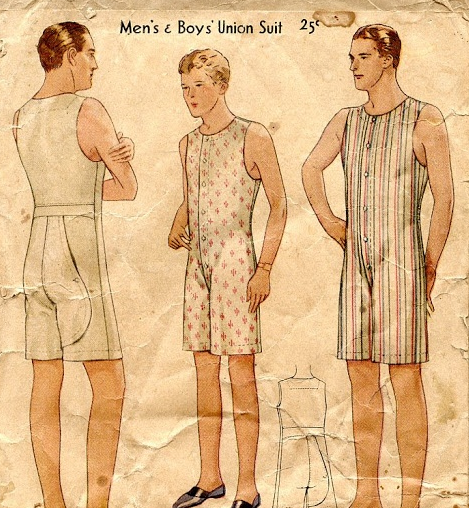
everytime u see a old photo of a snazzy 1920s dude in a suit remember what lurks beneath
okay why are you guys reblogging this and tagging it as reference do you plan on drawing 20s gangsters in their underwear i better see these
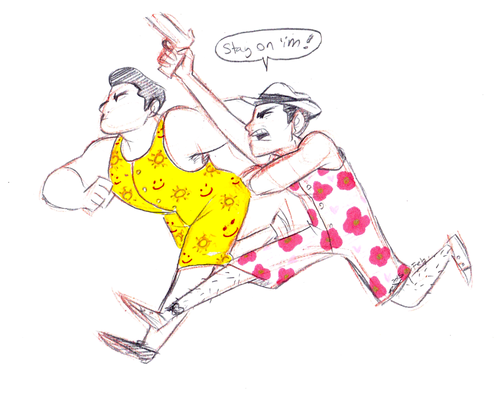
I couldn’t help myself
To be fair, underwear that fully covers the body from neck to knees makes a lot of sense when you’re wearing a dry-clean-only suit as your everyday outfit; it prevents sweat from soiling the garment’s inner layer, and thus lets you go longer between launderings. The development of modern underwear tracks pretty much directly with the shift to washable daywear, which removes much of the need for such extensive protection.
The part that makes least sense is how it’s sleeveless and thus doesn’t protect suits from armpit sweat. Surely the armpit is one of the most important places to put this kind of undergarment? T-shirts were originally designed as an undergarment that does protect clothing from armpit sweat, but they weren’t popularized yet in the 20s.
Most union suits did indeed have full or partial sleeves; the ones pictured in the original post are more fashionable than functional, probably intended to be worn with eveningwear.
Wow this was informative
Eveningwear? So… this is 1920s men’s lingerie. GTK







 backup from Tumblr